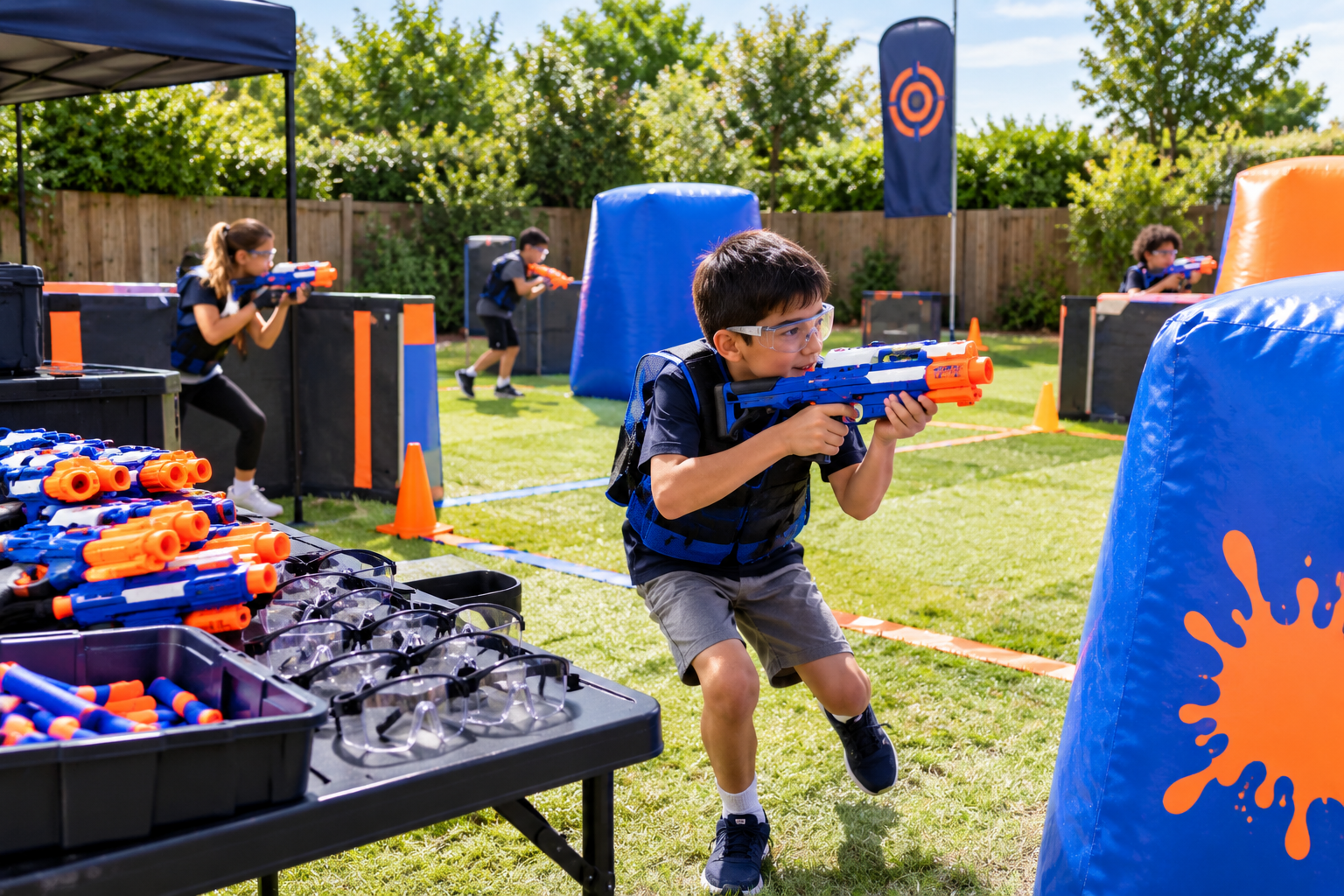
Nerf battle parties work best when you have three things in place: a clearly marked play area, mandatory eye protection for every player, and two or three structured game modes so the action never turns into aimless running. Get those right and the rest of the party mostly runs itself. The sections below cover each one, along with the setup and flow details that separate a smooth party from a chaotic one.
Anyone who has hosted a foam-dart party knows the first ten minutes decide everything. If kids get blasters in their hands before they hear the rules, you spend the next two hours refereeing. If they get a quick briefing, a team color, and a clear goal, they settle in fast. That’s also why a well-run Nerf birthday party often wins over trampoline parks and indoor play centers: the kids are active, engaged, and in charge of the story for the whole two hours.
Start With the Arena
The space you choose shapes every other decision, so settle it before you buy anything.
A backyard works well if it has some natural cover like shrubs, a playhouse, or patio furniture. Skip areas near pools, steep drops, or fragile garden beds. Indoors, a garage, basement, or large rec room can work, but clear out anything breakable and pad sharp corners. Parks and community spaces are another good option, though it’s worth confirming their rules on foam-dart play and cleanup before you book.
Whatever you choose, mark the boundaries. Cones, rope, or bright tape on the ground is enough, because kids respect a line they can actually see. Then set aside a safe zone just outside the arena where players can reload, grab water, and catch their breath without being targeted. This one small area cuts down on arguments more than any other rule.
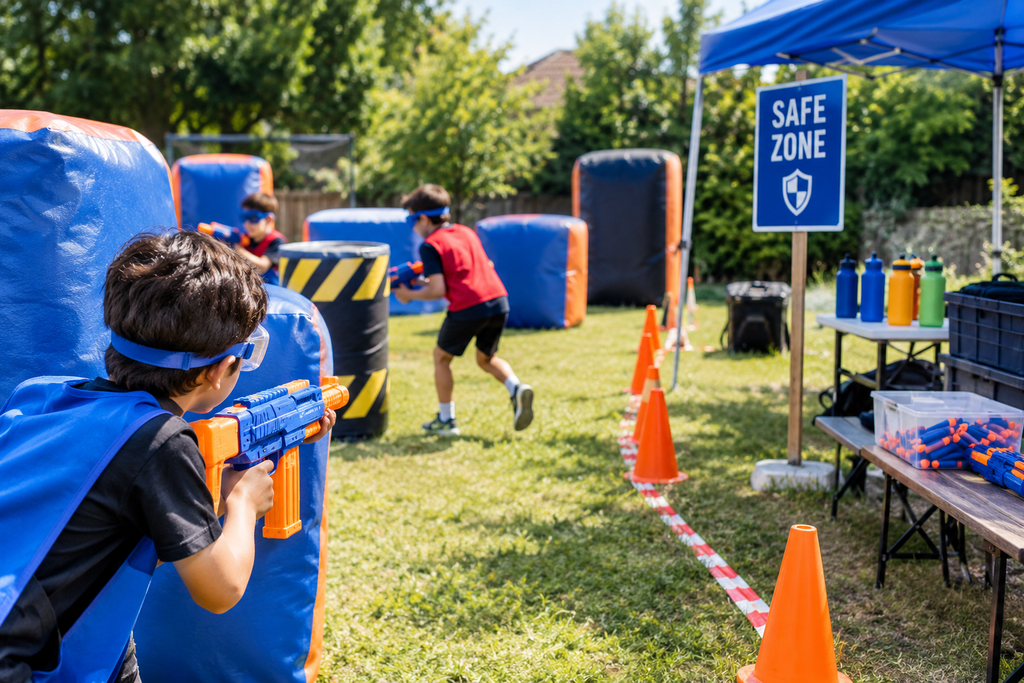
If you’re short on space, don’t stress. A smaller arena with plenty of cover is more exciting than a huge open field where nothing happens.
Safety Rules That Keep the Day Fun
Foam darts are soft, but eyes are still eyes. Protective eyewear is the one rule with no exceptions. The American Academy of Ophthalmology publishes guidance on toy-related eye injuries that is worth reading before any blaster event, especially if younger siblings are joining in.
Here are the ground rules we’d recommend announcing out loud before the first round:
- Safety glasses or goggles stay on from the first dart to the last, including during breaks inside the arena.
- Only official foam darts or darts made for the blasters in use. Modified or homemade ammo can hit much harder than it looks.
- No aiming at faces, and no shooting from point-blank range. A simple “a few steps apart” rule handles most complaints.
- Blasters stay pointed at the ground or the sky in the safe zone.
- One adult acts as referee and can call a pause at any moment.
Say them, don’t just post them. Kids absorb a rule far better when they hear it, and when it’s framed as part of the game. Many hosts call it the “mission briefing,” which gets even the most distracted kid to listen.
Paperwork matters too. With a professional team, parents usually complete a liability waiver ahead of time, so party day stays focused on the kids instead of forms. And if you’re unsure about age limits, equipment, or how a hosted event works, the frequently asked questions page covers most of what parents ask before booking.
Game Modes That Hold Attention
Free-for-all shooting is fun for about six minutes. After that, kids need a goal. These modes are easy to explain and work across most age groups.
Team Elimination is the classic. Two teams face off, and when a player is hit, they walk to a respawn spot, count to ten, and return. You can explain it in thirty seconds, which matters when impatient kids are holding loaded blasters.
Capture the Flag adds real strategy. Each team guards a flag, which can be a towel or bright cloth, and tries to grab the other team’s. Hit players freeze briefly. Kids who normally hang back often love this one because there’s more to do than just shoot.
Protect the VIP gives one player on each team a special marker, like a bright vest or hat. The team wins by taking out the opposing VIP. It creates natural roles: bodyguard, scout, decoy. Everyone has a job, which keeps quieter kids involved.
Zombie Survival is a great finisher when energy is high. One or two players start as zombies with limited ammo while the rest defend a base. Every defender who gets hit joins the zombies. Rounds are short, chaotic, and easy to replay.
Medic Missions are worth adding if you want to include kids who don’t love the shooting side. A medic can revive teammates by tagging them, so there’s always a role that matters without needing to be the best shot.
For younger kids, around five to seven, keep rounds to ten minutes or less and skip complicated scoring. Older kids and teens can handle bigger arenas, longer rounds, and objective-based play with multiple stages. Bigger crowds, like cousins, classmates, and neighbors all in one yard, are where a full-scale Nerf gun war party format really shines, since split teams and multiple objectives keep everyone busy.
Setting Up the Gear Station
Quantity matters more than quality here. Having a blaster for every child beats having a few premium ones that cause fights. A mix of basic spring-action models and a few motorized or flywheel blasters gives variety without creating a “who got the good one” problem.
Plan for more darts than you think you need. They vanish into bushes, under furniture, and into pockets. A “dart recycling station,” which is just a bin where kids toss collected darts, keeps ammo flowing so the game never stalls.
Barricades make the arena feel like an actual battlefield. You don’t need anything fancy. Cardboard boxes, pool noodles propped upright, folding tables turned on their sides, and inflatable obstacles all do the job. What matters is that players have somewhere to duck, peek, and plan.
Team identifiers matter too. Colored bandanas, wristbands, or pinnies let kids see at a glance who’s on which side, and they cut down on friendly-fire disputes. It’s a small detail with a surprisingly big payoff.
If gathering all of this sounds like a lot, the party packages at BattlePartyHQ include blasters, foam darts, protective gear, vests, barricades, and flags, so you can skip the shopping and the setup.
Running the Party Flow
A two-hour party tends to work best with a loose rhythm. You don’t need to run it like a military operation, but a plan stops those awkward gaps where kids drift off.
Begin with an arrival window where kids get fitted with eyewear and choose a team color. Follow with a short safety briefing, then a warm-up round so everyone learns how the blasters load and fire. After that, rotate through two or three game modes, with short breaks between them for water and snacks.
Save cake and presents for the end, when everyone is tired and happy. Closing with a big final battle, like a “last stand” where both teams join forces against a few adults, is a reliable crowd-pleaser. It’s also the moment that turns an ordinary Nerf battle birthday party into the one kids still talk about at school on Monday.
When things get chaotic, call a quick ceasefire. A whistle, an air horn, or a shouted signal works, as long as kids know in advance that it means freeze and listen. Resetting for thirty seconds usually saves the round.
Adjusting for Mixed Ages and Group Sizes
Siblings tag along, and guest lists rarely include kids of exactly the same age. A few adjustments help the day stay fair.
Pair older kids with younger ones so they can share strategy, and give older players small handicaps, like fewer lives or a slower blaster. For larger groups, split into more than two teams or run two games at once in separate zones. For smaller groups, shrink the arena so the action stays close. Eight kids in a tight space is far more exciting than eight kids scattered across a huge lawn.
Group size also affects how many adults you need. As a rough guide, one referee for every eight to ten kids keeps things under control, and a second adult handling snacks, darts, and first aid means the main referee can focus on the game.
Handling the Tricky Moments
Every battle has a few. Someone insists they weren’t hit. Someone is upset about being eliminated early. Someone wants to quit halfway through.
For hit disputes, an honor system works best, paired with a gentle reminder that the game is only fun when everyone plays fair. Kids who are out early can take on a useful job, like becoming a medic or the referee’s assistant. And for kids who want to step away, let them rest at the snack table without pressure. Many jump back in after a few minutes once they’ve cooled down.
If a child seems overwhelmed, it’s perfectly fine to shorten a round or switch to a calmer activity. A good party works for the kids who are actually there, not for a perfect schedule.
Small Touches That Make the Day Memorable
Some of the best details cost almost nothing. A printed mission card for each player, a custom team name, or a simple scoreboard on a whiteboard adds to the feel. Sending kids home with a “mission complete” badge or a few extra darts gives parents something to remember the party by.
Don’t forget the adults. If parents are staying, a shaded seating area and a cold drink go a long way. A comfortable parent is usually the one telling other parents your Nerf battle parties are worth attending, and it’s the reason so many parent reviews mention how easy and stress-free the day felt.
It also helps to be realistic about your own limits. When you’re hosting your child’s birthday, you’re the photographer, snack manager, referee, and host all at once. Many families choose to bring in a professional host for their Nerf battle parties so they can actually enjoy the day instead of chasing darts and settling disputes.
Ready to turn your next birthday into an epic showdown?
BattlePartyHQ brings the blasters, safety gear, barricades, and trained game coordinators straight to your doorstep across Lakewood Ranch, Manatee, and Sarasota Counties. Book your Nerf battle party today to lock in your date, or call 571.523.3151 and we’ll help you plan the perfect event.
Frequently Asked Questions
What age group suits Nerf battle parties best?
Most kids from six up enjoy them, with the sweet spot around seven to twelve. Younger children can join with simpler rules and close adult supervision.
How many kids should I invite?
Eight to fifteen is a comfortable range. It’s enough for real team play without making the arena feel crowded.
Is eye protection really necessary?
Yes, every player should wear safety glasses or goggles for the whole game. Professional hosts provide them, so you don’t have to count on guests bringing their own.
Can I host a Nerf party indoors?
Yes, as long as you clear breakables and have enough open space. Garages, basements, and large halls all work well.
How long should the party run?
Around two hours covers setup, a few game rounds, and cake without anyone running out of energy.
Leave a Reply